Augmented Reality Narratives for Post-Traumatic Stress Disorder Treatment
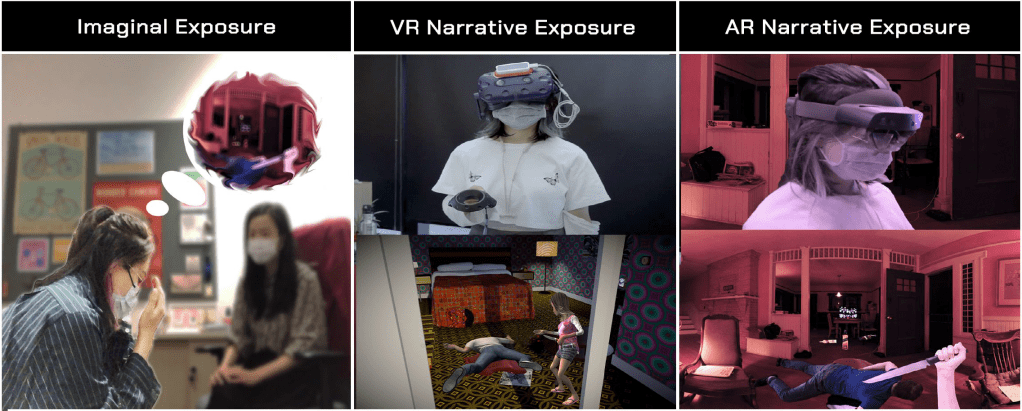
Abstract: “Globally, it is estimated that up to 1 billion children aged 2–17 years, have experienced physical, sexual, emotional violence and neglect” [1], and 30% of the abused child is likely to develop Post-traumatic stress disorder (PTSD) [2]; 354 million adult war survivors are suffering from PTSD [3]; At where the natural disaster occurred, 70.7% of survivors will suffer from acute PTSD [4]. PTSD has not only high prevalence but also high lethality, which is accompanied by multiple physical and mental comorbidities as well as strong suicidal tendencies [5-7]. This doctoral research aims to contribute to the development of PTSD treatment by investigating the potential of Augmented Reality (AR) narrative in treating PTSD. This four-year research project consists of three steps. In the first stage of research, we will conduct a comparative study between AR and VR narratives with participants without mental illnesses to verify whether AR narratives work better in eliciting the emotional engagement of the participants than VR narratives. In the second stage, we will create a system that integrates AR narratives with prolonged exposure (PE) treatment and experiment it with PTSD patients to verify its treatment efficacy. In the final stage, a semi-automatic and patient-authored AR system is expected to be achieved, through which the patients can design their unique exposureenvironment via voice input. This doctoral research project will provide valuable experimental samples and scientific evidences for the research of psychotherapy, narrative studies, and AR application.
Augmented Reality Narratives for Post-Traumatic Stress Disorder Treatment. / Chang, Liu; Cassinelli, Alvaro; Sandor, Christian.
Adjunct Proceedings of the 2020 IEEE International Symposium on Mixed and Augmented Reality: ISMAR-Adjunct 2020. IEEE, 2020. p. 306-309 9288433 (Adjunct Proceedings of the IEEE International Symposium on Mixed and Augmented Reality, ISMAR-Adjunct). PDF
A Mixed Reality Installation to Elicit Reflexivity on Adverse Childhood Experiences
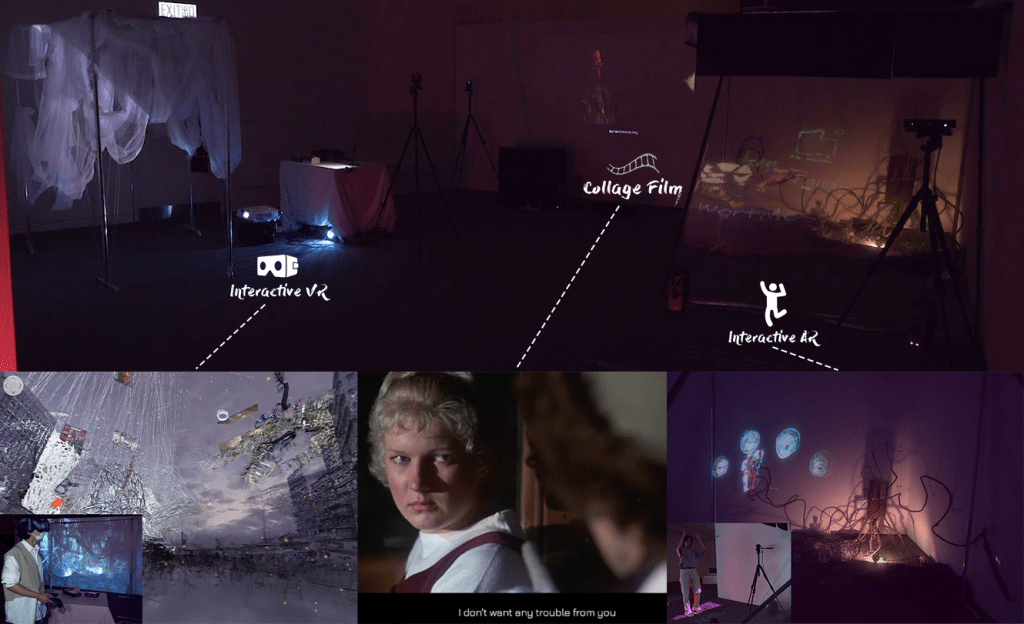
Abstract: Adverse childhood experiences (ACEs) are an underestimated public health threat. It impairs children’s brain development, immune system, and hormonal systems. These impairments predispose children to various chronic mental and physical dis- eases. However, its negative impacts are not widely known by the general public. Chang Liu created a mixed reality (MR) installation based on her personal experience with ACEs and ACEs related Post-traumatic stress disorder (PTSD), which aims to provoke the audience’s reflection on ACEs and the in- fluence of their upbringings on their mental and physical de- velopment. We conducted semi-structured interviews with 12 audiences, and their response to this MR installation was ana- lyzed using the thematic analysis method. The analysis proved that this MR installation is capable of eliciting the audience’s reflection on ACEs and their upbringing. In addition, The VR experience enabled participants to emotionally and somatically experience several symptoms of PTSD, and 75% of the partic- ipants demonstrated a high level of emotional self-awareness during the VR experience. Lastly, the analysis revealed that participants who had never encountered ACEs are more likely to sympathize with both the victim and abuser in a fictional narrative about ACEs than those who had undergone ACEs.
A Mixed Reality Installation to Elicit Reflexivity on Adverse Childhood Experiences. / Liu, Chang; Sandor, Christian; Cassinelli, Alvaro.
PROCEEDINGS – ISEA2022 Barcelona: POSSIBLES, 27 International Symposium on Electronic Art. ed. / Pau Alsina; lrma Vila; Susanna Tesconi; Joan Soler-Adillon; Enrie Mor. Universitat Oberta de Catalunya, 2022. p. 423-430. PDF
An Augmented Reality Installation to Metaphorically Represent the Causes, Manifestations, and Consequences of School Bullying in East Asia
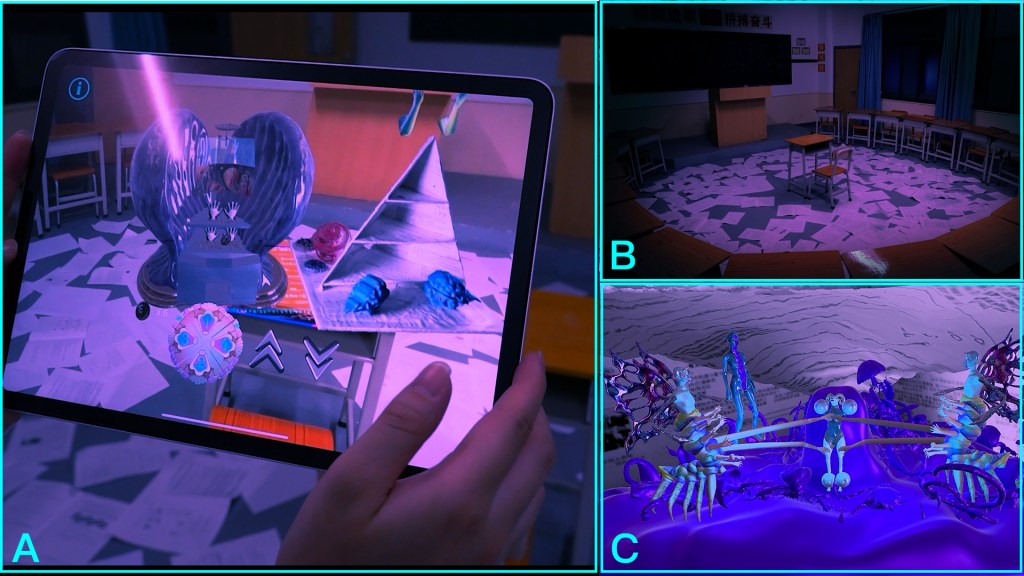
Abstract: “This article discusses the contributing factors, manifestations, and consequences of school bullying in East Asia. Moreover, this article delineates our creation of an interactive Augmented Reality (AR) artwork that conveys the aforementioned discov- eries metaphorically. We elaborated on the design of game mechanisms that enable players to experience emotions that many East Asian parents felt, which foster a deeper reflec- tion of the school bullying in East Asia. These emotions ex- perienced by East Asian parents include feelings of frustra- tion and anxiety that arise from financial constraints, as well as a sense of powerlessness when they have no choice but to pressure their children to succeed in the national college en- trance exam. Lastly, we present a novel approach to AR sto- rytelling: visualize the inner feelings of individuals affected by traumas through both the design of the virtual component and the arrangement of the actual location where the trauma happened(see Figure1).”
An Augmented Reality Installation to Metaphorically Represent the Causes, Manifestations, and Consequences of School Bullying in East Asia / Liu, Chang; Cheuk, Chloë SzeWing; Cassinelli, Alvaro.
Proceedings – ISEA 2024, International Symposium on Electronic Art. 2024. PDF
 Chang Liu (LUNA)